

Stocks: a slice of the pie
The world of investing can feel more complex than it needs to be. Financial news is full of jargon, forecasts, acronyms and confident opinions about what markets might do next. Most investors do not need to spend much time on any of this – and most would do well not to. A simple understanding of what stocks – also called shares or equities – are, how stock markets work and why broad diversification matters is usually far more useful than trying to interpret every headline.
Investors are generally seeking to grow their wealth over time. One way to do this is to buy a share of a company, in the expectation that the value of that ownership stake will rise and that the company may distribute some of its profits to shareholders as dividends. Another is to lend money to a borrower, such as a company or government, in the form of bonds, receiving interest along the way and your capital back. Shares tend to deliver less predictable outcomes over shorter periods, but they have historically offered the prospect of higher long-term growth than bonds.
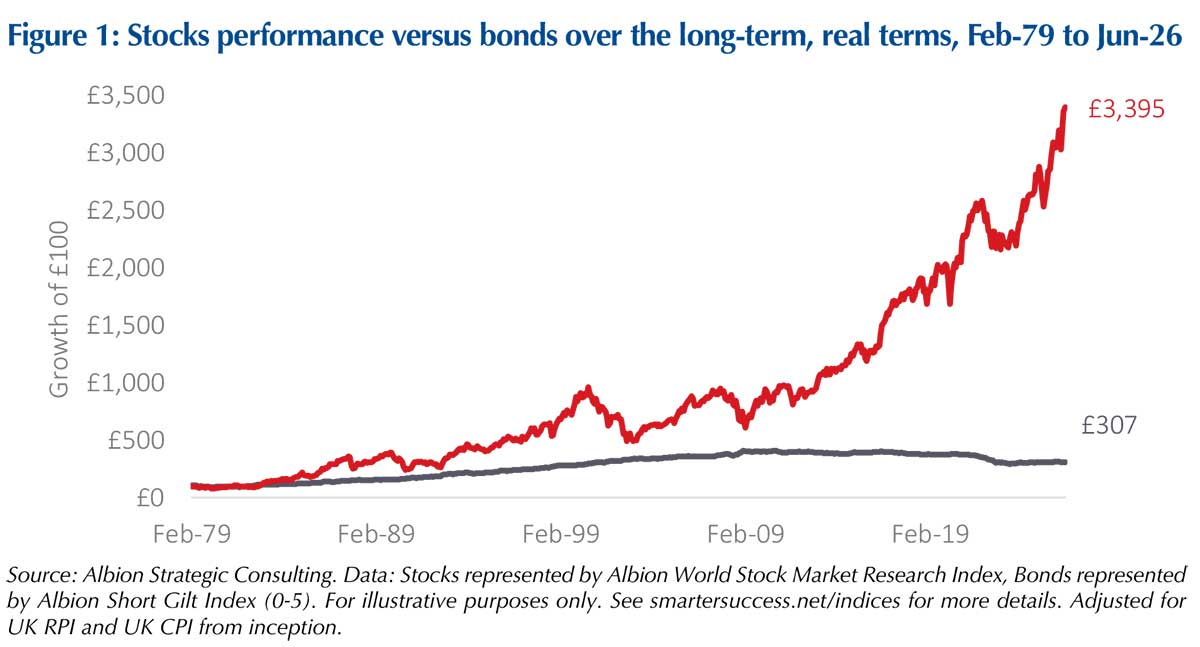
To have bought and sold stocks in – the late 1700s, one would have had to visit a bench under the buttonwood tree outside 68 Wall Street to have participated in the New York Stock Exchange. Thankfully, today buying a share in a company is a relatively straightforward process with the technology to hand. In fact, data show that in the US in 2024, nearly 60% of households held stocks, and on average a staggering 12bn shares changed hands every day (SIFMA Research, Capital Markets Fact Book, 2025).
Buying a share makes an investor a part-owner of a business. Shareholders have a claim on a proportion of the company’s future profits and, in many cases, a vote on important corporate matters.
If the company is wound up, shareholders sit behind lenders and other creditors in the queue, which is one reason shares are riskier than bonds. That risk is also why investors expect to be compensated with the possibility of higher long-term returns.
From a company’s perspective, issuing shares can be a way to raise capital to invest in the business, fund expansion or strengthen the balance sheet. This is most visible when a company first ‘lists’ on a stock exchange, or when an already-listed company sells new shares. Once those shares are in circulation, however, most day-to-day trading takes place between investors rather than between investors and the company itself. Consider that in 2024, an average of over $600bn worth of shares changed hands between investors every single day, yet across the entire year, just $200bn worth of new shares were issued.
When a share price rises or falls on the stock market, the company is not usually receiving or losing that money directly. Instead, buyers and sellers are agreeing a new price for the same ownership claim. The price reflects the market’s collective view of the company’s future prospects, taking into account expected profits, risks, interest rates, competition and countless other pieces of information. For this reason, the stock market is a forward-looking machine.
For most investors, a sensible route to ownership is not to try to pick the few companies that will be the big companies dominating the future, but rather to own a diversified basket of companies with the comfort that tomorrow’s winners will be in there somewhere. Evidence tells us that just 46 firms accounted for half of the $91 trillion in net wealth created by the US stock market over the century to 2025 (Bessembinder, One Hundred Years in the U.S. Stock Markets, 2026).
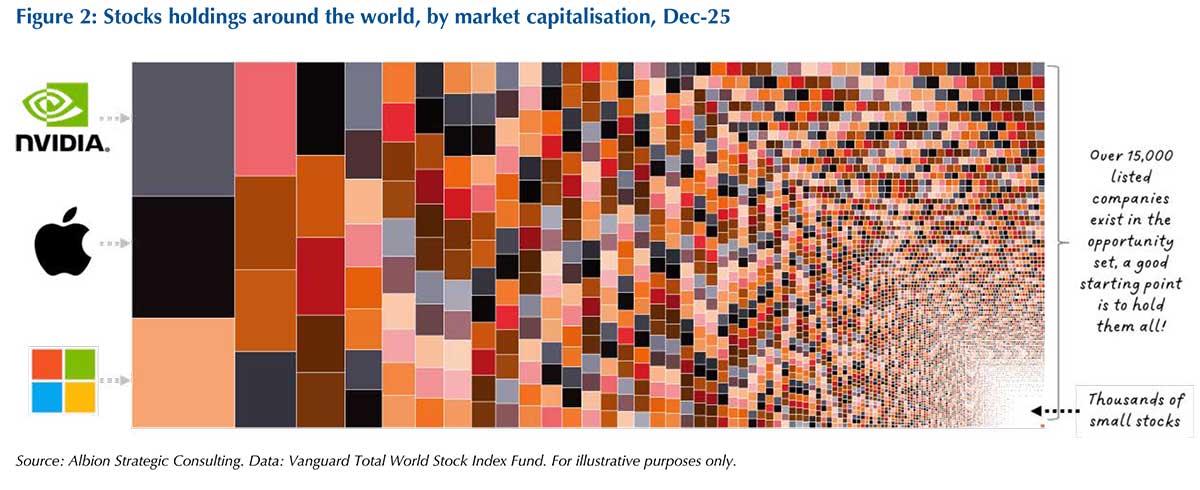
The composition of the market changes over time as some businesses grow, others shrink, and new companies emerge. A broadly diversified portfolio allows investors to own a small slice of many companies at once, with weights that adjust as market values change. This is a simple and efficient way to participate in the growth of listed businesses around the world.
Funds also make the practical administration of share ownership much easier. Instead of buying, selling and monitoring individual shares, investors can delegate these tasks to a fund manager. In many cases the manager will also vote on shareholders’ behalf on matters such as board appointments, executive pay and wider environmental, social or governance issues.
The key takeaways
- A share in a company provides the owner with a claim on part of the underlying business and its future profits.
- Most stock market trading takes place between investors, rather than between investors and the companies themselves.
- Share prices move as the market updates its view of a company’s future prospects.
- A market-cap-weighted global equity portfolio gives larger companies larger weights, while still providing exposure to many thousands of listed businesses.
- Diversified funds allow modern investors to access global equity markets efficiently, while delegating administration and stewardship responsibilities to a fund manager.
Important notes
This is a purely educational document to discuss some general investment related issues. It does not in any way constitute investment advice or arranging investments. It is for information purposes only; any information contained within them is the opinion of the authors, which can change without notice. Past financial performance is no guarantee of future results.
Products referred to in this Articule
Where specific products are referred to in this document, it is solely to provide educational insight into the topic being discussed. Any analysis undertaken does not represent due diligence on or recommendation of any product under any circumstances and should not be construed as such.