
Retirement age gap widens as expectations fall short
The gap between desired and actual retirement age is widening.
In late September, the Department for Work and Pensions (DWP) issued its yearly update, “Economic labour market status of individuals aged 50 and over, trends over time”. About a fortnight later, Standard Life published a yearly revision of its Retirement Voice, a survey of attitudes to retirement based on a sample of 6,000 UK adults aged 18 to 80, weighted by age, gender and region. The press release accompanying Standard Life’s document highlighted an issue that was also covered by the DWP: retirement ages.
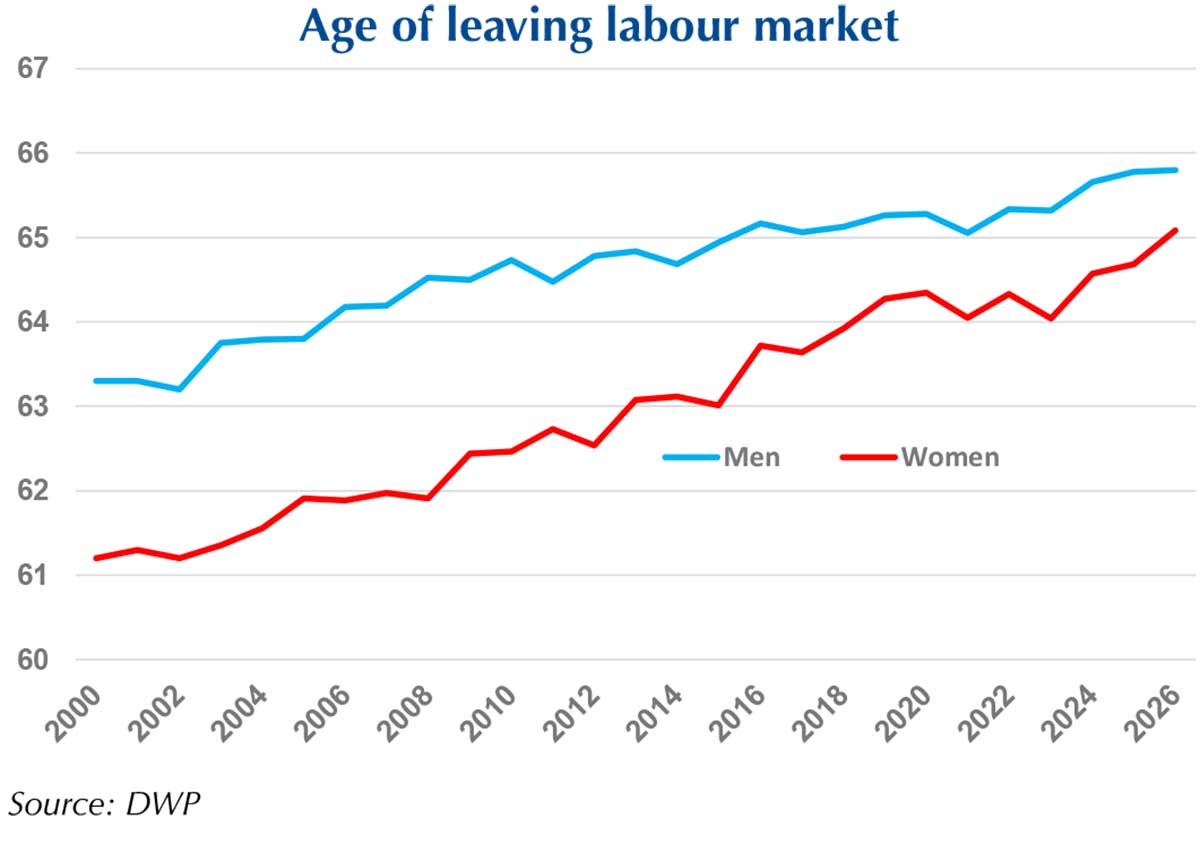
The DWP’s approach was much drier than Standard Life’s offering, rebranding retirement age in ‘DWP speak’ as “the average age of exit from the labour market”. The rising exit age trend since the turn of the century (shown in the graph) has undoubtedly been influenced by the increase in state pension age (SPA). However, it is worth noting that although women’s SPA remained at 60 until 2010, their average age of exit rose by 18 months over the preceding decade. The SPA has been the same for men and women since the end of 2018 and is currently rising from 66 to 67, a process due to be completed by April 2028. The Retirement Voice examined two versions of retirement age:
- When people wanted to retire, and
- When people expected to be able to retire.
The average desired age was 62.3, but the expected age was 67.6. This is a gap of 5.3 years – the highest it has ever been. In the 2024 survey, the corresponding figures were 62.0 and 66.4 – a 4.4-year gap. Just over half of those who had not yet retired expected to be working beyond their SPA. The latest DWP data shows that currently about one in four people aged 67 are in some form of paid employment, and even in the age 70–74 band nearly one in eight was still working.
Several reasons for the widening retirement age gap have been suggested, including:
- 26% of UK adults are struggling to get by on their current income.
- 63% worry that they are not saving enough for retirement.
- 48% said their retirement finances were mainly influenced by factors outside of their control.
Amid the gloom, there was one valuable finding. The smallest gap between hoped-for and expected retirement was for those who had undertaken the most retirement planning.