
A fresh bloom on company cars
Updated figures from HMRC reveal greener company cars are surging in popularity.
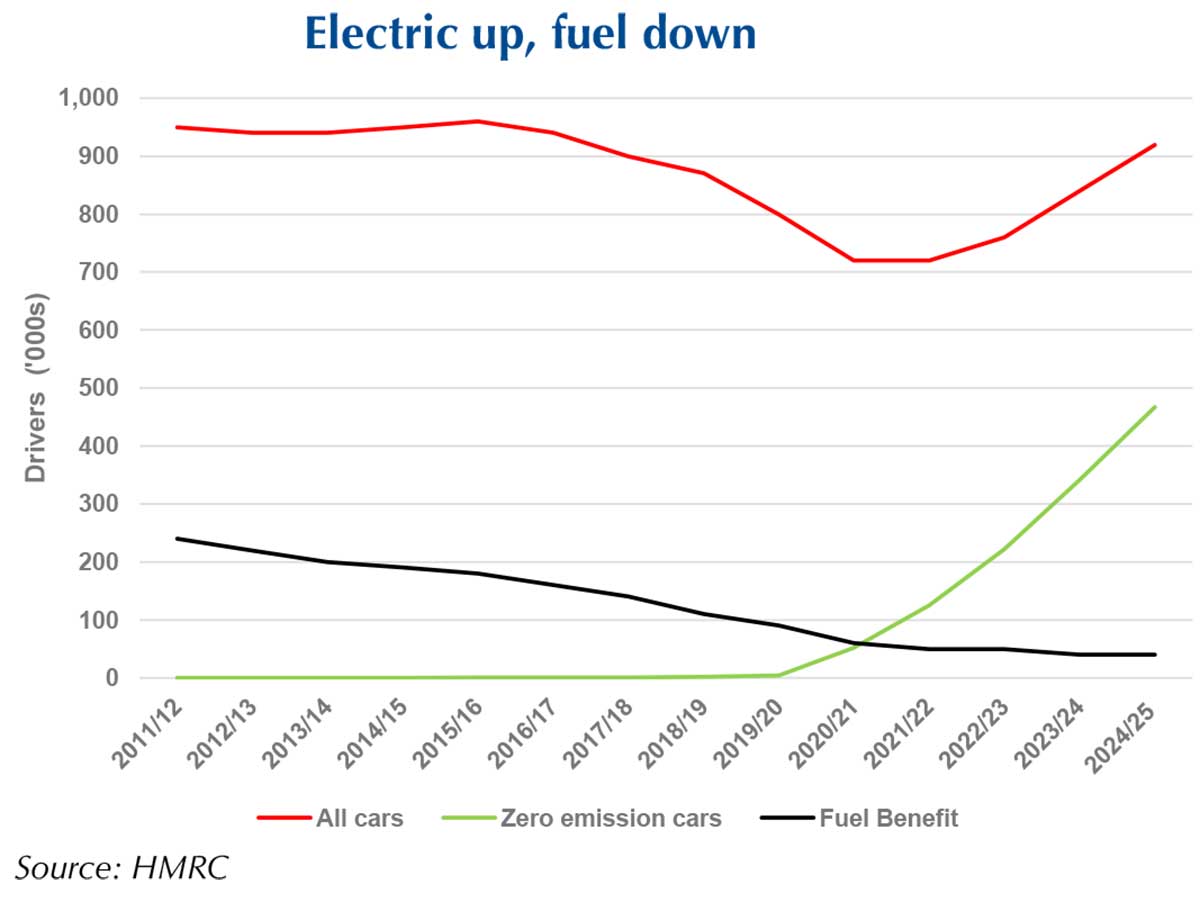
This summer’s slew of statistics on income tax issued by HMRC revealed an interesting picture of how company car ownership has changed since 2020. The total company car population (the red line in the graph above) slumped to a low of 720,000 in 2019/20 and in 2020/21 but then rose by over a quarter in the next four years to 920,000.
As the graph illustrates, the recovery is thanks to zero emission (virtually all electric) cars. In 2019/20, only 1% of company cars were zero emission, but by 2024/25, the proportion had risen to 51%. That compares to an overall share of about 5% for zero emission vehicles in the UK at the end of 2025, according to government data.
One other major trend, also related to the spread of zero emission cars, is that the proportion of drivers receiving ‘free’ fuel has fallen to a low of just 4%. Indeed, these changes have been driven by restructuring of the tax regime for company cars:
- Nine years ago, the rules for taxing company cars that were provided under salary sacrifice or similar arrangements were reformed. Often the consequence was to make salary sacrifice a much less attractive option because of an increased tax bill. However, there was a concession made for low emission cars (those with CO2 emissions of up to 75g/km). In 2017, there were few vehicles that qualified (and even fewer that appealed to company car drivers).
- Six years ago, for zero emission cars, the benefit-in-kind percentage charge (based on original value) was slashed from 16% to 0%. It has since crept up, reaching 4% for 2026/27. That compares, for example, with a scale percentage of 25% for a petrol BMW 320i.
Before you rush to choose an electric car, you need to know that the government’s future plans are less generous to zero emission. The scale percentage will rise in coming years and be 9% by 2029/30. As ever, what HMRC gives, HMRC can take away.
Tax treatment varies according to individual circumstances and is subject to change.
The Financial Conduct Authority does not regulate tax advice.